

The Fake Words That Kill Accountability
The cost of failing to speak plainly

Introduction
I’m overdue for a big old whinge up and there is something that I have been finding particularly irksome lately. Maybe the cynicism of middle age has finally started to catch up with me.
Here it is though.
I have a problem with how people speak in the office, in meetings, and just generally in corporate environments. You know what I mean, the soulless language which is heard all the time in offices up and down the land. It is sterile, non committal, and tries far too hard to sound clever. Phrases like circle back, touch base, or take that offline are common ways to say ‘we’ll talk about it later’ while sounding like a total ponce.
When I hear this stuff I get that ‘uncanny valley’ feeling. It’s like I’m being spoken to by a automaton trying to appear human.
There is a reason for this though.
There are features in the English language that have created this situation. There are two distinct sides to the language and one of these allows people to hide behind abstraction. The same language that also leads to a lack of accountability. We’ll need to go back in time to appreciate this . . . but I want to whinge a bit more first.
I work in security, so I deal with IT teams a lot. In some ways I have a double jeopardy when it comes to nauseating bullshit language. Aside from the regular set of words and phrases, there is a whole other dimension to it. Agile, for example, brought a whole avalanche of bullshit words and phrases to complement traditional corporate non-speak. Fail fast, ideation, synergise, buy in, and of course, the North Star. Whenever I hear about the North Star my mind goes to the countless explorers who followed hapless leaders to starvation in the Arctic tundra.
The corporate world is full to the brim with the language of bureaucrats, politicians, and academics. To some degree the corporate world has co-opted bureaucratic and technical language and morphed it into something else. Somewhere along the way, corporate language became a pastiche of precision. The need to describe things accurately was replaced with hollow platitudes.
Why does corporate language sounds fake?
The answer to this question is quite interesting and relates to the composition of the English language itself. It’s a game of two halves. Firstly there is Old English or Anglo-Saxon which is Germanic in origin, then there is Latinate which Norman in origin.
This duality is a carry over from the Anglo-Saxons having a Norman ruling class after the invasion of 1066 by William the Bastard. William defeated Harold Godwinson, the last Saxon King of England and this marked the ‘strategic realignment of leadership’ in England. The Norman conquerors came with their own traditions and their own language and replaced the aristocratic classes.
Saxon was the language of the commoner, French was the language of the ruling class and Latin the language of Church, law, and administration. French and Latin are part of the same family so both can be considered to be Latinate to keep it simple. This schism explains why there is duplication in the English language. Most things can be described with either a Saxon word or a Latinate one. The classic example relates to the different words for animals and their meat. Cow is the Anglo-Saxon word used by the farmers and beef from the French word boeuf is for the meat used by the Norman aristocrats.
Let’s put some numbers here. About 25-30% of the English language is Saxon, about 60% is Latin derived, a small residual from other sources such as Greek. The composition of the vocabulary does not translate to frequency of use. Day to day about 60% of the words used are Saxon however this decreases to around 50% for journalism and 25% for scientific or legal use. Latinate has a whole raft of infrequently used words.
Over time the two sides integrated into a single language, modern English. Now, this is something that is great about the English language. It is able to describe things in different ways and allows for description in different registers. It allows for texture and depth within speaking and writing but favouring one above the other doesn’t reflect how people speak. It might be grammatically correct but it doesn’t feel right.
The Saxon half of the language has a visceral connection to emotion. It is evocative and contained embedded judgements and a presupposed set of values. This allows less space for negotiation as it is absolute in some respect. It is concise, direct and carries weight. Good, bad, right, wrong, foul, shame . . . evil. By contrast Latinate words create distance by removing associations of shame. In some sense it is cowardly as it avoids direct confrontation. The abstraction requires processing and cognition which has a softening effect.
The Latinate side of English is defensive in the same way it is cowardly. The use of Latinate redirects towards action rather than the quality of a person. You might hear that they have made a misrepresentation, but what it really means is that they are a liar. You might also hear that an error was identified rather than we made a mistake. Within the abstraction emotional content is removed and action is separated from person.
The corporate world favours the Latinate side of the language as it deals in the abstract. It is removed from embedded value judgement. It is neutral and precise and for the uninitiated it elevates the perceived status of the speaker to a higher status. It is this mechanism that allow people to hide behind because it removes friction and makes critique difficult.
Accountability problem
There are significant consequences to all of this. Dealing in the abstract means that language starts to move away from the individual. Overuse of terms like “we” instead of “I” bring others into a shared space. It removes direct accountability or ownership from a person making a claim or statement. This has become a casual pattern of language which makes it harder to assign blame where it duly sits.
The composition of corporate language minimises bad consequences using Latinate descriptions. The emotional connectivity is severed and personal investment is reduced. This contributes in part to the erosion of accountability. The corporate euphemism comes into play as a mechanism of deflection. When you hear people talking about pivoting or minimum viable products that you know that someone has really dropped a bollock. In some respects the language in corporate spaces influences peoples thinking within those spaces. The use of language shifts conceptualisation from the individual towards a system or structure. This subverts the sense of individual agency and this is seen in the language that has emerged.
Technology trends creates its own language which act like DLC for corporate wank-speak. DevOps describes the anti-pattern of the hero and elevates groups above individuals. The servant leader of scrum agile subordinates leadership to a function of a collective. Whilst this is intended to address fragile systems it gives cover to fragile people which in itself, creates fragile organisations.
The language makes being exceptional in such an environment undesirable. The group is seen to be the primary unit and talented people who prefer independence can start to be seen as a problem. It means that accountability is pushed towards the group and has a diffusing effect. Consequences for failure cannot be put to a team as that is an indefensible position for many reason. Accountability without consequence is to be unaccountable.
The privileging of a collective provides the machinery which allows accountability and responsibility to be bypassed. This all reflects within corporate language. A person does not fail, it is a systemic failure, the mistake was not the act of a negligent person, it was a problem of organisational structure. Euphemism strips negative connotation from the established language of the outside world.
I’m undecided if the language is an influence or reflection but it is safe to say they are related.
Culture of ouroboros
Corporate language becomes a self propagating shit machine like a lawn sprinkler being fed by a plentiful supply of rusty water. Using it makes you one of the gang. There is an interesting aspect to group dynamics in that a shared vocabulary strengthens the identity of that group. I expect you have observed this yourself. A company might use the common set of bullshit terms. A team might have additional language based on discipline or specialism, I’ve already mentioned the language Agile and DevOps introduced.
This sense of shared identity also reinforces the group and erodes individual accountability. The Latinate nature of this language is abstract to outsiders further reinforcing the group identity. The group itself can become the enemy of someone with the balls to be held to account. In effect, the accountable become the outsiders and outsiders are the first enemy in close proximity.
This is as an expression of a corporate culture and the underlying systems and structures. The overuse of “we” may reflect a lack of organisational structures that promote accountability. This is also true of the other language patterns I have outlined such as corporate euphemism.
Language is one of the mechanisms that starts to create corporate culture. For some this is continuous improvement or a self renewing flow but in many ways it is like the snake eating its own tail, consuming itself. At the extremes it is destructive. In a best case accountability becomes as diluted as orange squash on sports day.
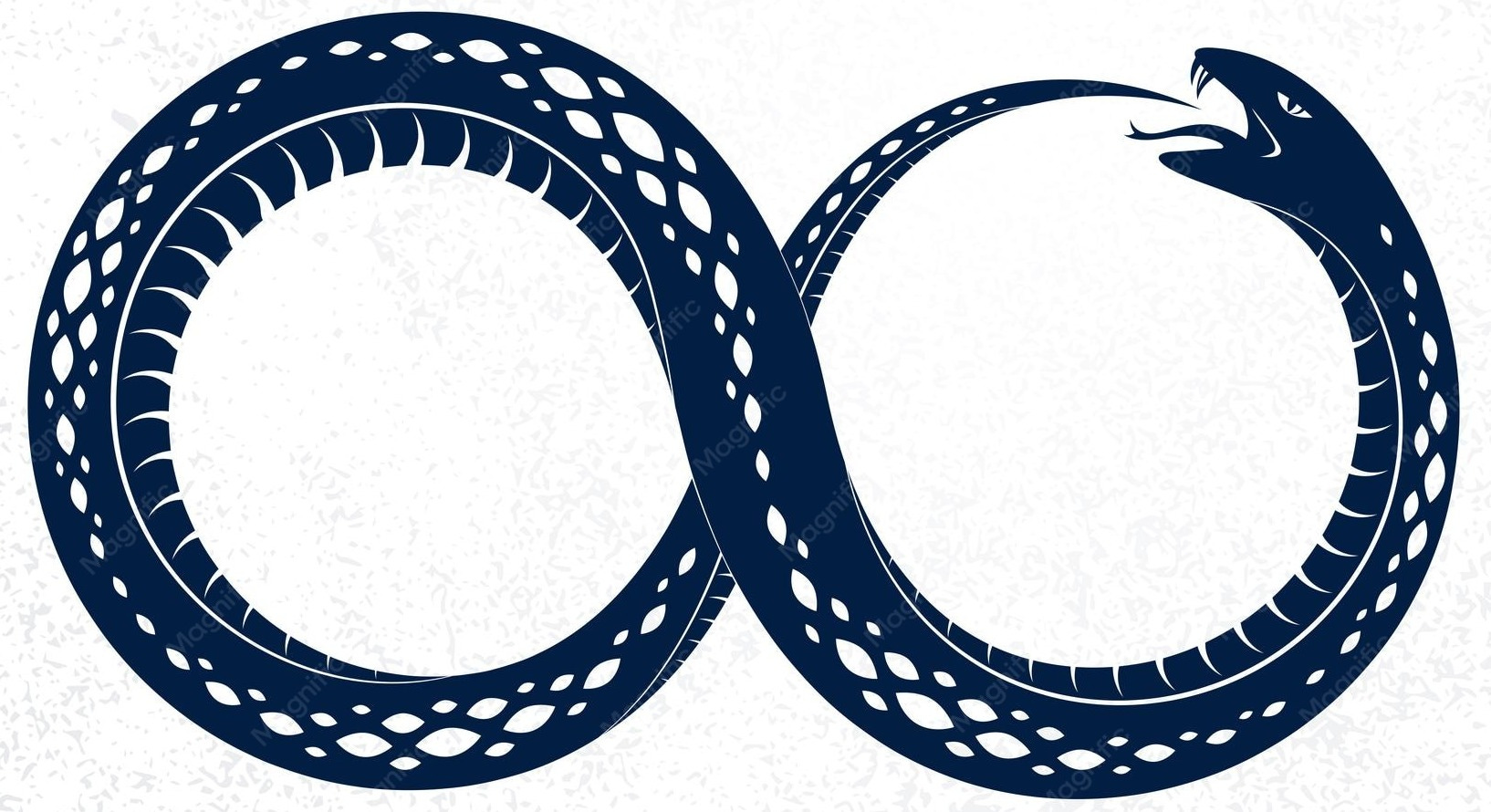
The Latinate corporate language both informs and reflects a culture where Individual is subordinated to the group, and creativity is subordinated to process.
When corporate language starts to become reflected in the technology, that’s when you know it’s really fucked. AI has been adopted widely in the work place and that is starting to introduce its own language patterns.
The AI problem
Corporate language has a flattening effect. It makes really clever ideas sound pedestrian but it also can give credibility to bad ideas. Much like how corporate language leans into Latinate to borrow credibility, bad ideas borrow from corporate language to sound credible. AI takes from both and makes the problem a whole lot worse.
AI has an uncanny knack of being able to package terrible ideas and make them sound credible using the cloak of corporate non-speak. In part, the problem has been created by the acceptance of such technology driven by technological vanity. The problem is that AI allows almost anyone to create documents, e-mails, and all sorts of bullshit that has a veneer of credibility. It is an average of an average.
You can always count on people to be lazy. All of the Big 4 have been rumbled selling AI generated trash as their leading industry perspective. One such example included fake citation, made up quotes, in a “thought leadership” piece making market predictions. Similar examples from other firms were sold to a government. A further comical example was included in a report about cyber threats which included fake citations, that particular firm had published a different report months earlier about executive overconfidence in AI adoption. As hilarious as it is concerning.
But of course, it’s natural for consultancies to embrace such technology with the vast amount of slideware they need to produce. AI fits the bill neatly for them, like a digital embodiment of Brian Blessed voiced by Russell Brand. The output is substantial yet shallow. All filler, no dinner.
Yet this is the trajectory of travel.
Conclusion
If you found corporate language annoying before then you need to know it will get a whole lot worse. It will become increasingly harder to pull out the diamonds among the turds. This is going to be a problem of quantity and quality. Many organisations have an addiction to pointless paperwork and AI will be able to fill that gap. AI will create document after document that says nothing. The AI output will then become the organisational context which is used to generate further pointless output.
This still sits on top of the fundamental problem of the language that is used in organisations that strips individual accountability and privileges process over creativity.
What is the solution to this problem? The path is clear. Let’s talk to each other like humans again. When someone uses some corporate bullshit, ask them what they mean. Where there are exceptional people, celebrate their success as it raises the standard. Where someone is shirking their responsibility then call it what it is.
What is needed is a rigid commitment to truth which is so desperately absent in the modern world. And it all starts with the words we use.